
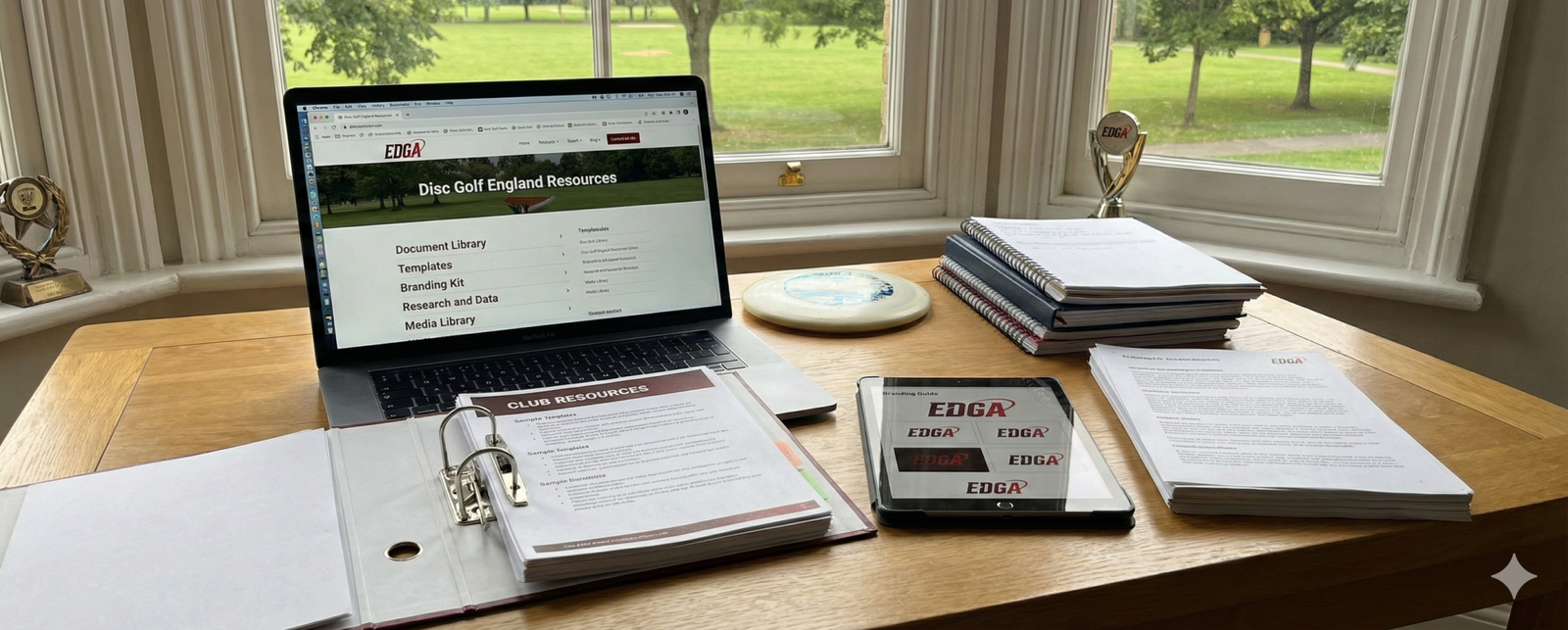
Running a disc golf club should not mean reinventing the same documents, checklists and messages every year. This page brings together practical support for club organisers in England, including volunteer roles, club nights, beginner sessions, meetings, finance, welfare, funding and community relationships.
The guidance here is intended to help clubs become more organised and sustainable. It does not mean that a club is listed, affiliated, approved or accredited by the English Disc Golf Association (EDGA). Clubs remain responsible for their own safeguarding, insurance, risk assessments, permissions and day-to-day management.
Support for disc golf club organisers
Most disc golf clubs are run by volunteers. A small amount of structure can make the club easier to run, easier to hand over and easier for new players, councils, landowners and partners to understand.
- Share responsibilities across a small organising group.
- Keep simple records of decisions, money, sessions and incidents.
- Use templates rather than starting from a blank page.
- Review documents when club activity changes.
- Make it clear how new players, parents, volunteers and local partners can contact the club.
Common club roles
Small clubs do not need a large committee, but it helps to know who is responsible for key tasks. One person may cover more than one role, especially while a club is forming.
- Club lead or chair: keeps the organising group moving and helps the club make decisions.
- Secretary or administrator: keeps basic records, meeting notes and correspondence.
- Treasurer or finance lead: records income and spending and helps keep club money separate from personal money.
- Welfare or safeguarding contact: helps the club respond to welfare and safeguarding concerns and supports safer practice.
- Course or venue contact: speaks with councils, landowners, course owners or venue managers.
- Sessions or events lead: coordinates regular club nights, leagues, beginner sessions or local events.
Role descriptions and related documents are available from the Club Templates and Forms page.
Running regular club sessions
Regular sessions are often the heart of a disc golf club. They help players build habits, welcome beginners and show local partners that the club is active and organised.
- Publish the time, meeting point and contact route clearly.
- Explain whether beginners can borrow discs.
- Give a short safety briefing before play starts.
- Check weather, course conditions and any known site issues.
- Make clear how juniors can attend and whether a parent or guardian must stay.
- Record incidents, near misses or welfare concerns when they happen.
- Review the session format if attendance grows or the site becomes busier.
Beginner-friendly club activity
Disc golf grows when new players feel comfortable turning up for the first time. Clubs can reduce the barrier by making beginner information obvious.
- Use plain language and avoid assuming people know disc golf terms.
- Tell people what to wear, where to meet and how long the session may take.
- Offer loan discs if the club has them.
- Pair new players with experienced players where possible.
- Use shorter layouts, doubles formats or guided groups for mixed abilities.
- Follow up with simple next steps, such as the next session date or club contact details.
Meetings, decisions and handover
Good records do not need to be complicated. A few notes can help future volunteers understand what was agreed and why.
- Record who attended important meetings.
- Write down decisions about money, roles, events, documents and permissions.
- Keep copies of policies, risk assessments, insurance documents and council or landowner correspondence.
- Agree who can access club email, social media, bank accounts and shared files.
- Review access when a volunteer changes role or leaves the committee.
Useful templates and forms
EDGA has prepared editable templates that clubs can download and adapt. These include a model constitution, code of conduct, risk assessment, insurance checklist, bank account checklist, welfare contact role description, incident report form, complaints procedure, photography guidance, junior session checklist and approach letters.
Visit Club Templates and Forms to download the full pack or individual documents.
Working with councils, landowners and community partners
When clubs speak to councils or landowners, it helps to be clear that disc golf is different from traditional golf. It does not require manicured fairways, greens, bunkers, irrigation, a clubhouse or exclusive use of large areas of land. Many disc golf activities use existing parks, woodlands or open spaces with light-touch layouts and respect for other users.
- Explain where and when the club plays.
- Describe how the club manages safety and other park users.
- Share a risk assessment summary where useful.
- Be clear about whether the club is informal, newly forming or formally constituted.
- Ask who the right council, parks or landowner contact is.
- Keep communication practical and local.
Funding and grants
Clubs may need funding for baskets, tee signs, beginner discs, storage, events, accessibility improvements or community sessions. The strongest funding applications usually explain who benefits, how the project will be delivered and how the club will manage money and risk.
For more information, visit Grants and Funding.
What to review each year
At least once a year, club organisers should check whether the club’s basic information and documents are still accurate.
- Club contact details and public links.
- Committee or organiser roles.
- Insurance policy and renewal date.
- Risk assessment and venue arrangements.
- Safeguarding and welfare contacts.
- Code of conduct and complaints process.
- Bank account access and finance records.
- Social media and shared file access.
Further updates
EDGA will continue adding practical resources as club support work develops. Updates may be shared through this website, news posts and the EDGA Facebook page.