
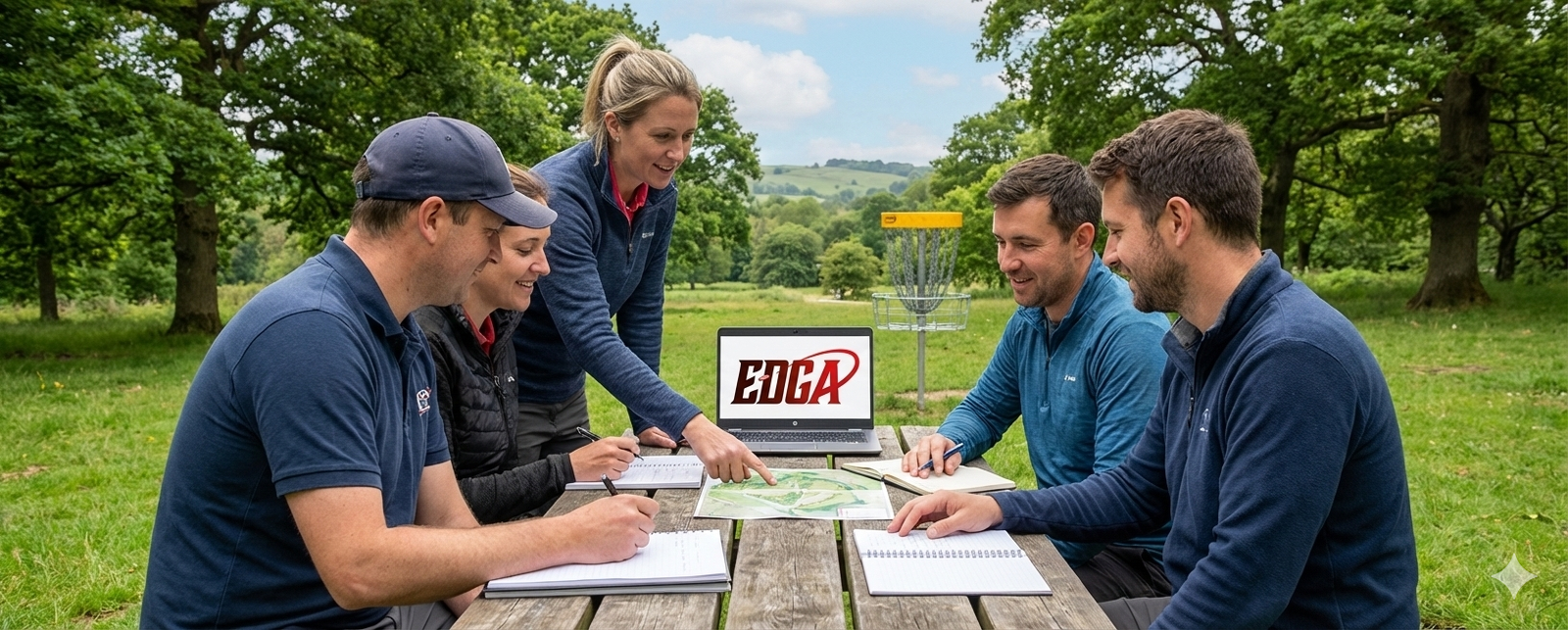
The English Disc Golf Association (EDGA) operates a transparent three-stage pathway to support disc golf clubs across England. The aim is to help local clubs become easier to find, easier to run, and better prepared when speaking with local councils, landowners, and community partners.
There is no fee for directory listings or during the initial affiliation pilot. Clubs progress through the pathway at their own pace.
The Three-Stage Club Pathway
Stage 1: Register Interest (Internal)
If you run a casual playing group, putting league, university club, or are developing a new course, registering interest connects you with EDGA.
- What you share: Basic details about your group, where you play, and what support you need.
- What you receive: Direct contact with EDGA, introductions to neighbouring clubs, and free access to governance starter packs.
- Visibility: Internal only. Registering interest does not place your club on the public directory or imply EDGA affiliation.
Stage 2: Listed Club (Public Directory)
The EDGA Club Directory helps beginners, casual players, and relocating disc golfers discover regular organised activity in their area.
To ensure directory entries provide a safe and credible reference for local communities, clubs complete a straightforward baseline governance check before being listed:
- Public contact route: A working website, Facebook group, Instagram profile, or public enquiry email.
- Venue and session details: Where and when you play (regular days and times), with beginner guidance.
- Junior participation statement: A clear statement regarding under-18 attendance (for example: under-18s welcome when accompanied by a parent or carer).
- Club Safeguarding Policy: An adopted policy naming your appointed Club Welfare Officer, or adoption of EDGA’s standard Accompanied Minors Policy for adult or parent-supervised meetups.
- Club Constitution or Rules: A basic document showing club officers, non-profit status, and adoption date (or a statement of informal community group or council course status).
Note: Stage 2 applications are sent directly to club contacts after completing Stage 1.
Stage 3: Affiliated Club (In Development)
Formal affiliation is being developed in consultation with our pilot clubs and the EDGA Board. It will provide a recognised national framework for established clubs seeking formal affiliation with the national governing body. Full details and criteria will be shared as the pilot progresses.
Free Starter Templates & Welfare Guidance
You do not need to draft policies from scratch. EDGA provides free pre-formatted Microsoft Word templates aligned with standard community sports practice on the Club Templates and Forms hub:
- Model Club Constitution
- Club Safeguarding Policy Template
- Club Welfare Officer Role Description
- Club Risk Assessment Template
Safeguarding Training Expectations
Training does not block your directory listing. For clubs running junior-specific sessions, you only need an adopted safeguarding policy and a named Club Welfare Officer on file; training can be marked In progress or Not yet completed. For informal groups and clubs operating an adults-only or accompanied-minors policy, adopting EDGA’s standard Accompanied Minors declaration satisfies this requirement without needing an appointed Welfare Officer.
For clubs running regular junior activity, we recommend introductory training such as UK Coaching’s 2-hour online course, Safeguarding and Protecting Children (ukcoaching.org). If your welfare contact already holds a certificate through their workplace (such as teaching or healthcare) or another sport within the last 3 years, EDGA recognises that directly as your club develops.
What Listing and Affiliation Mean (and Do Not Mean)
A directory listing confirms that a club has provided verified public contact details, declared its regular session times, declared its junior policy, and holds baseline safeguarding and governance declarations on file.
Listing or affiliation does not mean EDGA manages, supervises, inspects, or guarantees any club activity or venue. Every club remains independently responsible for its own sessions, volunteers, safeguarding compliance, insurance cover, risk assessments, and legal duties.
How this helps councils and landowners
Many councils and landowners want to know who is responsible for organised activity on a site. A clear club structure, named contacts, risk assessment, and insurance position can make those conversations easier.
It is also useful to explain that disc golf is different from traditional golf. Disc golf does not require manicured fairways, greens, bunkers, irrigation, a clubhouse, or exclusive use of large areas of land. Many disc golf activities use existing parks, woodlands, or open spaces with light-touch layouts and respect for other users.
Register your club’s interest (Stage 1)
All clubs start by registering interest. Tell EDGA about your club, where you play, and what support would be helpful. This takes around three minutes. Once registered, we will send you the Stage 2 Directory Listing details and help you adapt your starter templates.
For questions about club support, contact EDGA through the Contact page.